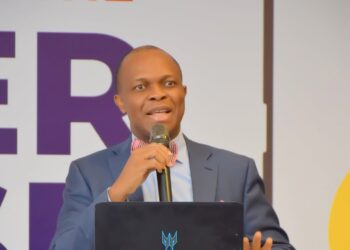
Political economist and former presidential candidate, Professor Pat Utomi, has criticised the ruling All Progressives Congress (APC), accusing the party of presiding over an economic decline that has significantly weakened Nigerians’ purchasing power.
Utomi made the remarks in a post on his X account on Wednesday, arguing that Nigeria was experiencing economic regression rather than mere stagnation under the APC-led administration.
He explained that while stagnation occurs when a country’s economic conditions remain unchanged over time, regression represents a deterioration in living standards, leaving citizens unable to afford goods and services they previously enjoyed.
To illustrate his argument, the economist used the example of car ownership, noting that a Nigerian who could afford a 2006 model in 2016 should, at the same level of financial standing, be able to purchase a 2016 model in 2026.
He said that if the individual could only afford the same 2006 model after 10 years, it would suggest that their economic circumstances had remained stagnant. However, being unable to afford even the older model would indicate a decline in purchasing power.
“There is a difference between a country that has stopped moving forward and one that is actively moving backwards. The first is stagnation, the second is regression. Sadly, Nigeria, under the APC, has become an example of the latter,” he said.
Utomi argued that the country’s economic difficulties had progressively eroded the purchasing power of ordinary Nigerians, making goods and services that were once considered affordable increasingly difficult to obtain.
He observed that the situation had gone beyond the failure to record economic progress, as many households were now struggling to maintain living standards they previously enjoyed.
“We are not simply standing still; we are losing ground, watching yesterday’s modest comforts become today’s luxuries,” he said.
Despite his criticism of the ruling party, the political economist maintained that Nigeria’s situation was not irreversible, urging citizens to recognise the power of their votes in determining the country’s political and economic direction.
He described the removal of leaders whom voters consider incompetent or corrupt through the ballot box as a civic responsibility, stressing that citizens have an important role to play in demanding accountability from those entrusted with public office.
“Bad leadership is not a life sentence. We have the power to change our country’s direction, and that power lies in our votes,” he said.
Utomi further called on Nigerians to reconsider their political choices and hold public officeholders accountable for their actions and the consequences of their policies.
“If we want to save Nigeria, we must stop rewarding those destroying it,” he added.
His comments come as political activities gradually intensify ahead of the 2027 general elections, with economic management, living costs and the performance of the current administration expected to feature prominently in public discussions.