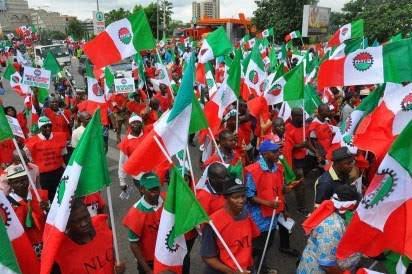
The Nigeria Labour Congress (NLC) has given the Federal Government a 14-day ultimatum to commence negotiations on a new national minimum wage and take urgent measures to reduce petrol prices, warning that failure to address its demands could lead to fresh industrial action.
The ultimatum, which commenced on Friday, October 9, 2026, followed a joint meeting of the union’s National Executive Council and Central Working Committee in Abuja, where labour leaders expressed concern over the worsening economic conditions facing Nigerian workers.
The congress wants negotiations on a new minimum wage to begin before the end of October, arguing that the current wage has lost much of its purchasing power amid the depreciation of the naira and the rising cost of essential goods and services.
In a communiqué signed by its President, Joe Ajaero, the NLC said workers were increasingly struggling to afford basic necessities, including food, housing, healthcare, transportation and education. It called for a living wage that reflects prevailing economic realities and guarantees workers a decent standard of living.
The labour union also urged the Federal Government to work with relevant agencies to bring down petrol pump prices, blaming repeated increases in the cost of petroleum products for driving up transportation fares, food prices and the general cost of living.
Beyond the minimum wage and petrol price demands, the NLC directed the government to implement, within the ultimatum period, the terms of settlement reached with the Joint Health Sector Unions and Assembly of Healthcare Professionals (JOHESU) on February 5, 2026, while addressing additional demands arising from the agreement.
It also called for the implementation of outstanding demands by the Joint Public Sector Negotiating Council (JPSNC).
Meanwhile, the Association of Senior Staff of Banks, Insurance and Financial Institutions (ASSBIFI) has urged the Federal Government to introduce measures to ease the economic burden on workers, particularly the escalating costs of food, transportation, healthcare, housing and education. The association also called for improved security across the country.
Speaking at the 2026 World Day for Decent Work commemoration in Lagos on Wednesday, ASSBIFI Acting National President, Fanimokun Adesina, criticised the inability of the current national minimum wage to meet workers’ basic needs.
Adesina said a situation in which the minimum wage could neither purchase a bag of rice nor adequately feed an average family of four for two weeks was unacceptable and inconsistent with the principles of decent work.
He stressed that Nigerian workers deserved dignity, fair treatment and wages capable of supporting their basic needs.
Adesina also described the year’s theme, ‘Young Workers Organising for the Future’, as timely, noting that trade unions needed to address succession challenges and prepare younger workers for leadership in an increasingly technology-driven workplace.
According to him, artificial intelligence, digitalisation, automation, platform-based employment, algorithmic management and outsourcing are already transforming the world of work, requiring unions to adapt their strategies to protect workers’ interests.
He further called on banks, insurance companies and other employers to respect workers’ freedom of association and allow employees to join trade unions of their choice without intimidation, threats or victimisation.
The ASSBIFI leader urged employers to uphold relevant International Labour Organisation standards, particularly Convention 87 on freedom of association and Convention 98 on the right to organise and collective bargaining, while also advocating ratification of Convention 158 on termination of employment.