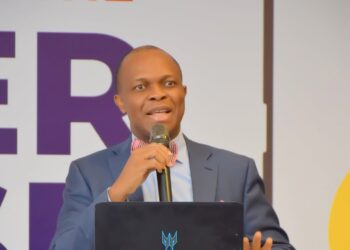
Former Kogi West senator and African Democratic Congress (ADC) chieftain Dino Melaye has raised concerns about the National Assembly’s handling of major government policies and constitutional issues, alleging that its leadership has not done enough to prevent excessive concentration of power in the Presidency.
Speaking to journalists on Wednesday, Melaye criticised Dino Melaye and House of Representatives Speaker Tajudeen Abbas, arguing that parliament must do more to hold President Bola Tinubu’s administration accountable.
He warned that a legislature that routinely fails to challenge executive decisions risks weakening the institutional safeguards upon which democratic governance depends.
In a statement examining the performance of the 10th National Assembly, Melaye discussed several contentious matters, including changes to police legislation, emergency rule in Rivers State, disputed versions of tax laws, electoral reforms and the monitoring of public expenditure.
He used the expression “lifetime presidency” to describe what he considers the gradual erosion of checks on presidential authority, clarifying that he was not claiming Tinubu had abolished constitutional term limits or intended to remain in office indefinitely.
Melaye maintained that although cooperation between parliament and the executive is essential to governance, it should not prevent lawmakers from independently examining government proposals or rejecting measures they consider contrary to the public interest.
The former lawmaker questioned the speed with which an amendment to the Nigeria Police Act was passed in July 2024. The legislation provided for an Inspector-General of Police to remain in office until the end of the tenure specified in his appointment, notwithstanding the ordinary retirement provisions.
According to Melaye, the bill completed all three readings in both chambers on the same day, raising questions about the depth of legislative scrutiny given to a measure affecting the leadership of the police.
He pointed out that the amendment benefited former Inspector-General of Police Kayode Egbetokun, who had served as Tinubu’s Chief Security Officer during the latter’s tenure as Lagos governor. He also noted that Egbetokun’s successor, Olatunji Disu, previously served as Tinubu’s aide-de-camp.
Melaye, however, acknowledged that these professional relationships did not establish misconduct by either police chief. His concern, he explained, was whether adequate institutional safeguards existed to protect the police from political influence, particularly during elections.
He argued that the credibility of law enforcement should rest on transparent rules and effective safeguards rather than assumptions about the personal independence of whoever occupies the office of Inspector-General.
The ADC chieftain also challenged the National Assembly’s approval of the state of emergency declared in Rivers State by Tinubu on March 18, 2025. He questioned the use of voice votes by the Senate and the House of Representatives, arguing that the procedure did not provide a clear, verifiable record showing whether the constitutionally stipulated two-thirds majority of all members had supported the proclamation.
For Melaye, the controversy highlights the need for parliament to demonstrate compliance with constitutional requirements whenever it considers measures involving exceptional executive powers.
He further drew attention to discrepancies reported between tax legislation passed by lawmakers and versions subsequently published in the official gazette. Citing a House of Representatives ad hoc committee report issued in January 2026, he said the committee had reportedly identified differences in key provisions after comparing certified copies of the laws with previously gazetted versions.
Although the House leadership subsequently released certified true copies, Melaye argued that the publication of corrected documents was not enough to resolve the controversy. He called for accountability over the circumstances that produced the discrepancies and clarification of whether those responsible had been identified.
Electoral legislation and parliamentary procedure also featured in his criticism. Melaye questioned the House of Representatives’ handling of a motion on February 17, 2026, concerning the reversal of its earlier position on mandatory real-time electronic transmission of election results.
He challenged Speaker Abbas’s ruling that supporters of the motion had prevailed, despite objections from those who claimed the opposing side had secured the louder response. The decision reportedly led to protests and disorder in the chamber.
Melaye said the incident raised concerns about how parliamentary decisions are established and recorded, arguing that the outcome of legislative proceedings should be determined through procedures that command public confidence.
He also questioned the omission of qualification as an expressly listed ground for challenging an election under Section 138 of the Electoral Act 2026, compared with Section 134 of the 2022 legislation. While recognising that the change did not remove constitutional eligibility requirements or make certificate forgery lawful, he called for greater clarity about its implications for election petitions.
The former senator extended his criticism to the National Assembly’s oversight of budget implementation and public spending, accusing lawmakers of failing to exercise sufficient scrutiny over the use of public funds.
Melaye’s position is that legislative independence must be demonstrated through effective oversight, transparent decision-making and a willingness to demand explanations from the executive. He warned that without these safeguards, Nigeria’s democratic institutions could become less effective in protecting constitutional governance and holding public officials accountable.