


Something is rotten in the kingdom of Nigerian religious pontification, and the increasingly ferocious clash between VeryDarkMan, popularly known as VDM, and Apostle Arome Osayi has merely ripped open the curtain. What began as a disagreement over Nigeria’s spiritual destiny has become a much larger confrontation about authority, accountability, arrogance and the dangerous tendency of some men of God to behave as though the anointing comes with immunity from interrogation. VDM may be crude, abrasive and occasionally reckless with his words, but there is a stubbornness to his questions that the Church cannot wish away simply by calling him a devil, an unbeliever or an agent of darkness. Sometimes the uncomfortable messenger is precisely the person asking the uncomfortable question.
At the heart of the controversy is Arome’s argument about Nigeria’s supposed divine assignment. His emphasis on revival and prayer, particularly when contrasted with the technological and economic advancement of countries such as China, understandably provoked VDM. The question VDM has raised is painfully simple: if other nations are building the things they need, why should Nigerians be told that our peculiar assignment is principally to pray? What exactly stops a nation from praying and building at the same time? Why should revival become an excuse for technological backwardness? Why should spiritual consciousness be presented as though it is incompatible with scientific curiosity, industrial development, entrepreneurship and disciplined governance? Nigeria needs God, yes. But Nigeria also needs factories. It needs laboratories. It needs engineers, researchers, manufacturers, inventors, competent administrators and leaders who understand that divine providence does not absolve human beings of responsibility.
This is why VDM’s China videos struck such a nerve. Beneath the mockery was a serious indictment. China did not build its infrastructure by conducting endless prayer meetings about roads. It built roads. It did not develop its manufacturing capacity by declaring that God would provide. It invested, planned, produced and persisted. The point is not that China has no spiritual life or that prayer is useless. The point is that nations do not develop merely because they pray for development. There is a difference between asking God for wisdom and refusing to use the wisdom one has been given. There is also a difference between faith and fatalism. Nigeria’s problem is not that Nigerians pray too much; it is that prayer is sometimes deployed as a substitute for the hard work of nation-building.
But the controversy becomes considerably more disturbing when the personality of the preacher enters the picture. How can an apostle reportedly say “I could have killed him” about someone regarded as a son in the Lord simply because of a disagreement? If those words have been accurately represented, they deserve more than a shrug from the Christian community. They demand examination. What kind of spiritual fatherhood speaks the language of killing when confronted with disagreement? What happened to meekness? What happened to patience? What happened to the instruction to restore a brother gently? And when did disagreement with a spiritual authority become sufficient grounds for language that evokes destruction? These are not questions raised by atheists seeking to ridicule Christianity. They are questions any serious Christian should be asking. A preacher who demands accountability from others must be prepared to submit his own words to accountability.
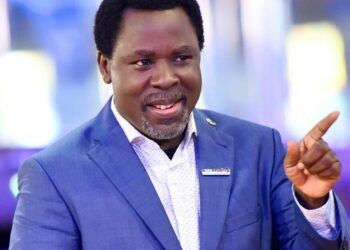
Then there is the matter of the late Prophet T.B. Joshua. Arome has previously been reported as describing the late televangelist as a “soothsayer”, a deeply disparaging characterisation that generated criticism from other Christian voices. One does not have to agree with everything T.B. Joshua taught or did to recognise the gravity of such a judgement. What gives one preacher the authority to sit in final judgement over another man’s spiritual life? Who appointed him examiner of the eternal credentials of another servant of God? If T.B. Joshua was wrong, let Scripture, theology and evidence establish the argument. But there is something profoundly troubling about the confidence with which some preachers pronounce verdicts on other ministers, particularly after death has removed the accused from the conversation.
And perhaps that is why the present controversy feels like payback time. Not divine payback. Not revenge. Rather, the return of the same public scrutiny that spiritual celebrities have often directed towards others. If you spend years making strong pronouncements about other people’s ministries, motivations and spiritual standing, you should not suddenly discover that scrutiny is persecution when the spotlight turns towards you. The pulpit cannot be a one-way courtroom in which the preacher is permanently the judge and everyone else is permanently the accused. Arome should therefore respect himself. He may have a large following, a formidable ministry and an impressive spiritual reputation, but none of those things makes him immune to questions.
And VDM is precisely the wrong person to attempt to silence through intimidation. He has built his public identity around confrontation. He thrives on controversy. He does not appear frightened by clerical titles, prophetic pronouncements or accusations of demonic influence. If anything, attempts to condemn him spiritually only provide him with more ammunition. Arome cannot win this battle by trying to out-prophesy VDM. Every new declaration creates another response. Every attempt to discredit him creates another video. Every accusation gives him another opportunity to ask questions that many ordinary Nigerians have wanted to ask but lacked the courage to voice publicly. This is not necessarily because VDM is always right. It is because he has mastered something the contemporary Church sometimes underestimates: the power of an irreverent question in an age of declining reverence for institutional authority.
But here is the part the Church must not miss: one does not have to be a pastor to have God’s hand upon his life. God has never restricted Himself to pulpits. Amos was a herdsman. David was a shepherd. Joseph was an administrator. Daniel served in government. Nehemiah was a cupbearer. The Bible is filled with people whom God used outside conventional religious structures. The assumption that God can only speak through men carrying apostolic, prophetic or pastoral titles is itself a dangerous form of spiritual elitism. VDM does not need a collar, a pulpit or a Bible school certificate before a question he raises can be valid. A man can lack theological sophistication and still identify hypocrisy. He can be abrasive and still expose contradiction. He can be wrong ten times and still be right on the eleventh question.
That distinction matters because VDM is not beyond criticism either. Some of his attacks are unnecessarily cruel. His tendency to ridicule people can undermine otherwise legitimate arguments, and there are moments when his appetite for confrontation appears to overwhelm his sense of proportion. But criticism of VDM’s methods must not become an excuse for avoiding the substance of his questions. The Church must learn to distinguish between the messenger and the message. If VDM is wrong, prove him wrong. If his interpretation of Arome’s words is defective, correct it. If his theological argument is weak, dismantle it with Scripture and sound reasoning. But calling a critic demonic does not answer his question. Neither does invoking one’s spiritual authority.
The Nigerian Church desperately needs this conversation because we have reached a point where religious authority is sometimes confused with intellectual infallibility. A pastor can be gifted and still be wrong. An apostle can be anointed and still be arrogant. A prophet can hear from God and still misunderstand a matter. A bishop can preach the Gospel and still make an indefensible statement. Spiritual authority does not abolish human fallibility. If anything, the greater the influence, the greater the responsibility to speak carefully.
Nigeria also cannot afford a Christianity that teaches people to pray while discouraging them from thinking. We cannot keep telling young Nigerians to wait for miracles while celebrating societies that are producing the very infrastructure, technology and opportunities we are asking God to give us. We cannot condemn intellectual questioning as rebellion and then complain that the younger generation is leaving the Church. The answer is not less Christianity. It is a more intellectually honest Christianity. A Christianity confident enough to be questioned. A Christianity humble enough to admit mistakes. A Christianity that understands that prayer is not an alternative to work, and faith is not an excuse for incompetence.
Perhaps this is why the VDM-Arome confrontation matters more than the personalities involved. It is a collision between two very different Nigerias. One Nigeria still reveres the pulpit and assumes that the man behind it possesses a special immunity from ordinary scrutiny. The other Nigeria is armed with smartphones, scepticism, Google, TikTok, YouTube and an almost pathological refusal to accept authority simply because authority demands obedience. The second Nigeria may be noisy, vulgar and occasionally unfair, but it is here, and the Church cannot exorcise it.
So perhaps Armageddon is already upon us. Not the cinematic Armageddon of fire descending from the heavens, but an intellectual Armageddon in which inherited authority is being dragged into the public square and forced to defend itself. The battle is no longer simply between VDM and Arome. It is about who gets to define truth, who has the right to ask questions and whether Nigerians will continue surrendering their intellectual agency at the altar of religious celebrity.
Arome should therefore take a breath. Respect himself. Answer the questions. Leave the intimidation behind. And remember that the man shouting from outside the pulpit may sometimes be asking a question that those inside the pulpit desperately need to answer. The era of unquestioned pontification is ending.